

If you’re planning to become a nurse, physical therapist, or pursue any advanced health profession, you need to read this carefully. The Department of Education just made a decision that could cost you thousands of dollars—and it’s causing outrage across the country.
Graduate students in nursing, physical therapy, speech-language pathology, social work, and other allied health fields are suddenly facing a harsh reality: they’ve been excluded from the government’s definition of “professional degrees.” This isn’t just a technical classification—it directly affects how much money you can borrow for graduate school.
Let me break down exactly what happened, what changed, and what it means for your future.
1. What Actually Changed
In July 2025, President Trump signed the One Big Beautiful Bill Act (OBBBA) into law. This legislation completely restructured how graduate students can borrow federal money to pay for their education. The changes take effect on July 1, 2026.
Here’s what’s different:
Old System (Before July 1, 2026):
- Graduate students could borrow up to $20,500 per year in Direct Unsubsidized Loans
- But they also had access to Grad PLUS loans, which covered up to the full cost of attendance
- Previously, certain health professions also had access to separate HEAL Program higher limits beyond Grad PLUS
- This meant if your program cost $200,000, you could borrow the entire amount through federal loans
New System (Starting July 1, 2026):
- The Grad PLUS program is eliminated for all new borrowers
- Students are now divided into two categories: “graduate” and “professional”
- Graduate students: $20,500 per year maximum, $100,000 lifetime limit
- Professional students: $50,000 per year maximum, $200,000 lifetime limit
- The Department applied a four-part framework to determine which programs qualify (based on CIP codes, educational length, licensure requirements, and specific criteria)
The difference between these two categories? $100,000 in borrowing power.
2. The Classification: Who Counts as “Professional”?
The Department of Education created a very narrow list of what qualifies as a “professional degree.” Only 11 programs made the cut:
- Medicine (M.D.)
- Osteopathic Medicine (D.O.)
- Dentistry (D.D.S. or D.M.D.)
- Pharmacy (Pharm.D.)
- Optometry (O.D.)
- Podiatry (D.P.M.)
- Veterinary Medicine (D.V.M.)
- Law (J.D.)
- Chiropractic (D.C.)
- Theology (M.Div.)
- Clinical Psychology (Psy.D., Ph.D.) — recently included as a compromise to broaden the definition
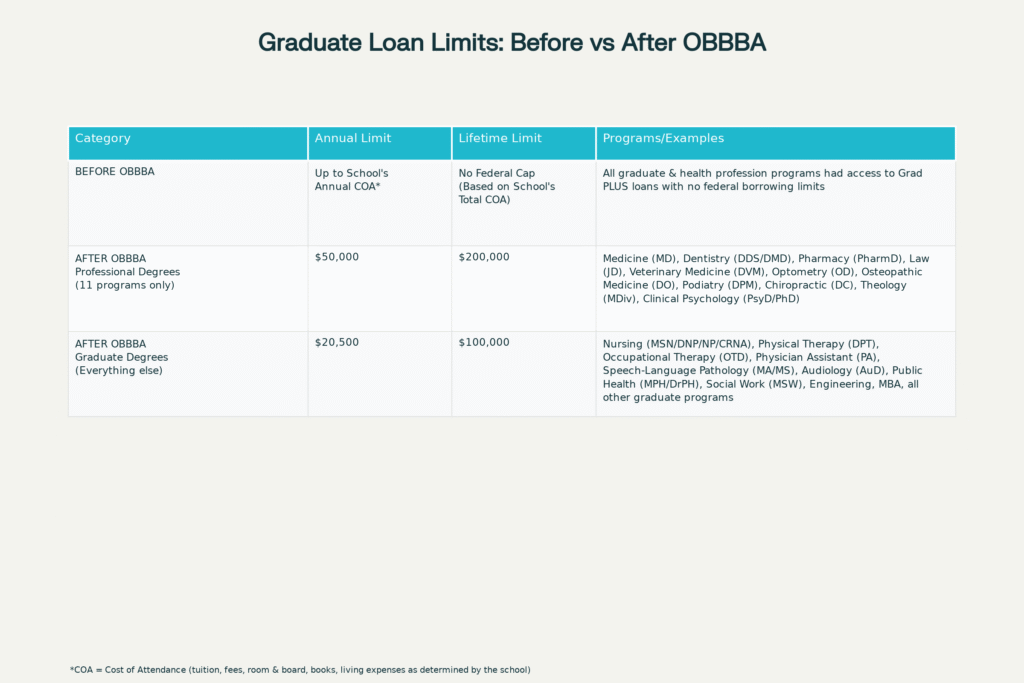
If your program isn’t on this list, you’re classified as a regular “graduate student”—even if you need a professional license, even if your degree costs over $100,000, and even if you’re training to save lives.
3. Who Got Excluded—And Why It Matters
Here’s where the controversy explodes. Dozens of health professions that require licensure, doctoral-level education, and years of training were completely left out. The Department’s definition will now cover approximately 47% of current doctoral-level students, which means the majority of graduate students fall into the lower borrowing category:
Nursing Programs Excluded
All graduate nursing programs lost professional degree status. This includes:
- Master of Science in Nursing (MSN)
- Doctor of Nursing Practice (DNP)
- Nurse Practitioner (NP) programs
- Certified Registered Nurse Anesthetist (CRNA) programs
The average CRNA program alone costs upwards of $200,000. Under the new rules, nursing students can only borrow $100,000 total—leaving them to cover the remaining $100,000 through private loans with higher interest rates.
Over 260,000 students are currently enrolled in BSN programs, and approximately 42,000 are in ADN programs. This change affects every single one who plans to pursue advanced education.
Allied Health Professions Excluded
Physical therapy, occupational therapy, physician assistants, speech-language pathology, audiologists, and respiratory therapy were all excluded from professional degree classification.
The average physical therapy graduate already leaves school with over $116,000 in student loan debt. Now they can’t access federal loans to cover it.
Public Health and Social Work Excluded
Master of Public Health (MPH), Doctor of Public Health (DrPH), and Master of Social Work (MSW) programs don’t qualify either. This is particularly alarming because these fields train the workforce that responds to public health crises, mental health emergencies, and social services needs.
Engineering and Business Excluded Too
Even professional engineering degrees and MBA programs—despite having professional credentials like “Professional Engineer” certification—were not included.
4. How the Department Defined “Professional Degrees”
The Department claims a “professional degree” must meet specific criteria based on their regulatory framework. But nursing, physical therapy, and social work all meet the stated requirements for professional practice, licensure, and advanced education beyond a bachelor’s degree.
Nurse practitioners need licensure and can’t practice without a graduate degree. Physical therapists must have a Doctor of Physical Therapy (DPT) to practice. Speech-language pathologists require at minimum a master’s degree for licensure. The Department’s approach relied on a regulatory definition framework, with guidance coming through a Dear Colleague Letter that will provide additional clarity on whether other programs might still qualify under the existing parameters.
The Department used a regulatory baseline from July 4, 2025—anchored to 1965 regulatory language—to determine which programs qualify. That’s before nurse practitioners even existed as a profession.
5. What People Are Searching For Right Now
Here’s what Americans want to know:
“Nursing no longer professional degree” – Breakout search term
Yes, it’s true. Nursing has been removed from professional degree eligibility for the higher federal loan limits.
“Professional degree list 2026” – Breakout search term
The official list contains only 11 programs: medicine, dentistry, pharmacy, law, veterinary medicine, optometry, podiatry, osteopathic medicine, chiropractic, theology, and clinical psychology.
“Degrees no longer professional list” – Breakout search term
Nursing, physical therapy, occupational therapy, physician assistant, nurse practitioner, CRNA, speech-language pathology, audiology, public health, social work, and engineering are NOT considered professional degrees under the new definition.
“Department of education professional degrees engineering” – Breakout search term
Engineering degrees are classified as graduate programs, not professional programs, despite the existence of Professional Engineer (PE) licensure.
“SLP professional degree” – Breakout search term
Speech-language pathology (SLP) master’s programs are classified as graduate degrees, not professional degrees, even though SLPs require licensure and a minimum master’s degree to practice.
“MSW no longer professional degree” – Breakout search term
Master of Social Work (MSW) programs are not included in the professional degree definition, despite requiring licensure (LCSW) for clinical practice.
“Reclassification of professional degrees” – Breakout search term
Professional organizations including the American Nurses Association, American Association of Colleges of Nursing, and others are actively pushing for reclassification before the July 2026 deadline.
6. How Much Money Are We Talking About?
Let’s look at real numbers:
Nurse Practitioner Program:
- Average total cost: $80,000 – $120,000
- Old system: Could borrow full amount via Grad PLUS
- New system: Limited to $100,000 total federal loans
- Gap to cover with private loans: $0 – $20,000+
CRNA Program:
- Average total cost: $150,000 – $200,000+
- Old system: Could borrow full amount
- New system: $100,000 federal limit
- Gap to cover with private loans: $50,000 – $100,000+
Doctor of Physical Therapy:
- Average total cost: $100,000 – $150,000
- Old system: Full borrowing available
- New system: $100,000 federal limit
- Gap to cover with private loans: $0 – $50,000+
Private student loans typically have higher interest rates than federal loans and don’t offer the same protections like income-driven repayment or Public Service Loan Forgiveness. The new Repayment Assistance Plan (RAP) rules are also part of OBBBA, creating different repayment scenarios than traditional income-driven plans. (Read our full Guide on RAP)
7. The Real-World Impact
On Students
Students from low- and middle-income families will be hit hardest. Wealthier families can afford to pay out-of-pocket or qualify for private loans more easily. Part-time students will face proration of loan amounts starting July 1, 2026, which creates additional complexity for those balancing work and education. (Read Our Full Guide: Part-Time Student Loans: What Proration Means for You)
Dr. Olga Yakusheva, a professor of nursing at Johns Hopkins University, told Newsweek: “With a cap on federal student loans, fewer nurses will be able to afford graduate nursing education”.
On Healthcare
The American Nurses Association warned this change could worsen the existing nursing shortage. Patricia Pittman, director of the Fitzhugh Mullan Institute for Health Workforce Equity at George Washington University, called it “a gut punch for nursing” and said it threatens workforce retention, especially in rural and underserved communities.
On Professional Status
Being excluded from “professional” classification feels like an insult to hundreds of thousands of licensed professionals who went through rigorous graduate training. One social work forum described it as delegitimizing fields that require state licensure and professional boards. Additionally, individual schools now have the ability to implement institutional program-level caps, which means specific programs at specific universities may impose limits beyond the federal maximums.
8. What Happens Next
Timeline:
- Now – June 30, 2026: Current students who have already borrowed Grad PLUS loans can continue using them for up to 3 more years or until graduation, whichever comes first
- July 1, 2026: New loan limits take effect for all new borrowers
- Beyond 2026: Professional organizations will continue pushing for reclassification
Legacy Provision:
If you’re already enrolled in a graduate program before July 1, 2026, and have borrowed federal loans, you can continue borrowing under the old limits (including Grad PLUS) for up to three academic years or until you complete your program, whichever is shorter.
Important: This only applies to students continuing in the same program at the same school. If you switch programs or schools after July 1, 2026, the new limits will apply.
9. What Students Should Do Now
If you’re planning to start graduate school:
- Apply for loans before July 1, 2026 if possible to lock in the legacy provision
- Research private loan options to understand backup financing
- Calculate total program costs including living expenses, not just tuition
- Look for scholarships and assistantships to reduce borrowing needs
- Consider program length and cost when choosing schools
10. Professional Organizations Fighting Back
The American Association of Colleges of Nursing (AACN) released a statement declaring: “Excluding nursing from the definition of professional degree programs disregards decades of progress toward parity across the health professions and contradicts the Department’s own acknowledgment that professional programs are those leading to licensure and direct practice”.
The American Nurses Association said: “At a time when healthcare in our country faces a historic nurse shortage and rising demands, limiting nurses’ access to funding for graduate education threatens the very foundation of patient care”.
Similar statements have come from physical therapy, public health, and social work organizations.
The Bottom Line
Starting July 1, 2026, if you want to become a nurse practitioner, physical therapist, speech-language pathologist, or pursue dozens of other advanced health professions, the federal government will loan you a maximum of $100,000 for your entire graduate education.
If you want to become a doctor or lawyer, you can borrow up to $200,000.
The difference? A regulatory framework decision based on specific criteria that hasn’t been updated to reflect modern healthcare professions.
Thousands of students are now facing a choice: take on expensive private loans with less favorable terms, abandon their career plans, or hope that professional organizations succeed in getting these programs reclassified before the deadline.
For nursing alone—with over 260,000 students currently in BSN programs—this could fundamentally reshape who can afford to enter the profession. And at a time when America faces critical shortages in nursing, physical therapy, and mental health professionals, that’s a risk we might not be able to afford.
The Department of Education is expected to release additional guidance in the coming months. Students should monitor announcements from their schools’ financial aid offices and professional associations for updates.